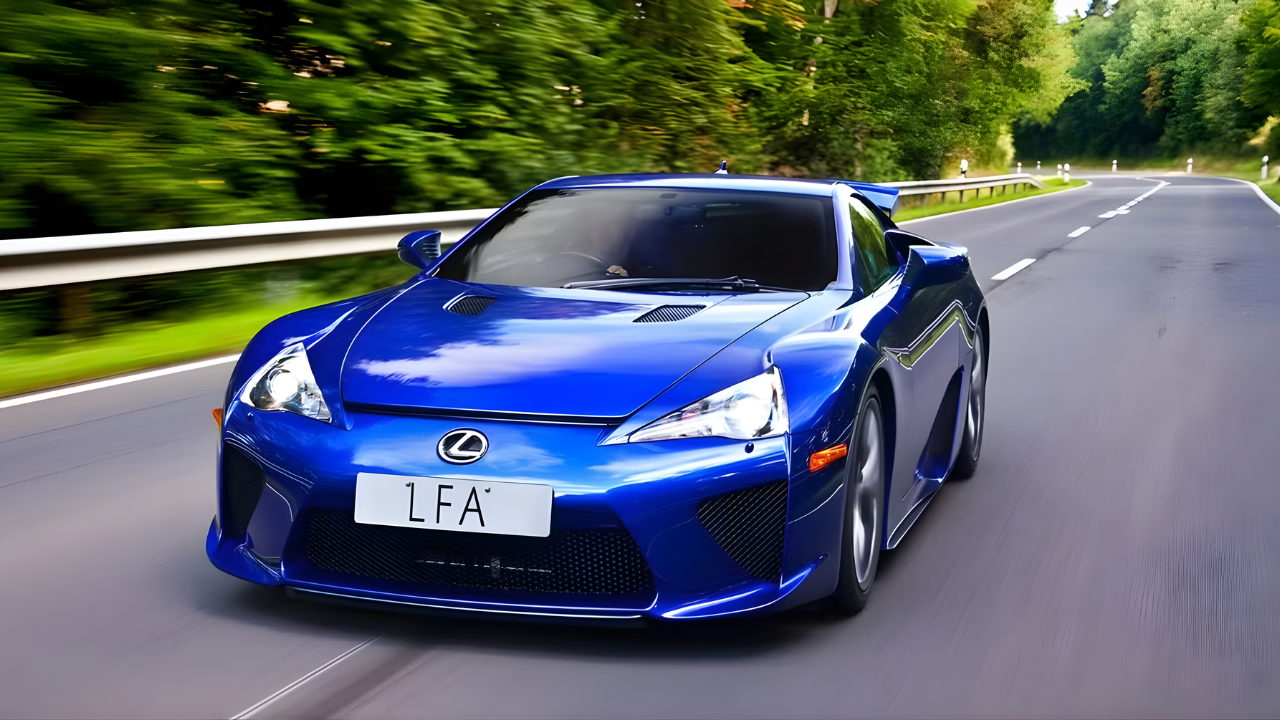
The automotive world is often obsessed with the cold, hard logic of numbers, focusing on shaving milliseconds off lap times or adding increments of horsepower. However, every few decades, a machine emerges that transcends the spreadsheet to become a visceral experience. The Lexus LFA is precisely that machine. Born from a decade-long development cycle that saw Toyota’s engineers restart the entire project from aluminum to carbon fiber midway through, the LFA was never about profit margins. It was a statement of intent—a demonstration of what happens when a brand known for reliability decides to build the most emotive car on the planet. From its screaming V10 engine to its obsessive attention to detail, the LFA isn’t just a supercar; it is a masterpiece of mechanical art that feels more alive than almost anything produced in the modern era of hybrid assistance and turbocharging.
Engineering Perfection through Carbon and Titanium
What sets the LFA apart from its contemporaries is the sheer extremity of its construction. To achieve the rigidity and lightness required for world-class handling, Lexus developed its own circular carbon fiber loom, allowing them to weave the car’s chassis in-house. This dedication to structural integrity resulted in a vehicle that is incredibly communicative, telegraphing every nuance of the road through the steering wheel and seat. Under the hood lies the heart of the beast: a 4.8-liter V10 engine co-developed with Yamaha. This power unit is a marvel of miniaturization, possessing the physical footprint of a traditional V8 and the weight of a V10, yet it revs with such ferocity that a traditional analog needle couldn’t keep up. Lexus had to install a digital tachometer simply because the engine could climb from idle to its 9,000 RPM redline in just 0.6 seconds. This level of responsiveness creates a symbiotic relationship between the driver’s right foot and the car’s propulsion, making every downshift feel like a lightning strike.
| Feature | Specification |
| Engine | 4.8L 72-Degree V10 |
| Power Output | 553 hp @ 8,700 RPM |
| Torque | 354 lb-ft @ 6,800 RPM |
| 0–60 MPH | 3.6 Seconds |
| Top Speed | 202 MPH |
| Transmission | 6-Speed Automated Sequential |
The Greatest Soundtrack in Automotive History
While the performance figures are impressive, the LFA’s true claim to fame is its acoustic signature. Often described as the “roar of an angel,” the exhaust note was tuned by Yamaha’s music division to evoke the sound of a 1990s Formula 1 car. The engineers treated the cabin like a concert hall, installing “sound channels” that funnel the intake and exhaust frequencies directly to the driver’s ears. This isn’t the synthesized, speaker-pumped noise found in many of today’s performance cars; it is raw, mechanical music. As the revs climb past 6,000 RPM, the exhaust note transitions from a guttural growl to a high-pitched, metallic wail that resonates through the chassis. It is an intoxicating sensory overload that justifies the car’s existence on its own. For many enthusiasts, the LFA represents the pinnacle of internal combustion audio, a hauntingly beautiful swan song for the naturally aspirated engine.
A Masterclass in Ergonomics and Driver Connection
Inside the cockpit, the LFA continues to defy convention. Eschewing the cluttered dashboards of the early 2010s, Lexus created a driver-centric environment that feels futuristic even by 2026 standards. The centerpiece is the moving central gauge cluster, which physically slides to the side to reveal sub-menus, a tactile detail that highlights the car’s “gadget-forward” Japanese heritage. Every surface is draped in high-quality Alcantara, leather, or exposed carbon fiber, and the seats are positioned as low as possible to lower the center of gravity. Unlike modern supercars that often feel isolated or overly assisted by electronic safety nets, the LFA demands your full attention. The single-clutch automated manual gearbox provides a physical kick with every shift, reminding you that this is a mechanical device rather than a computer simulation. This focus on the “human-machine interface” ensures that the LFA remains rewarding to drive at 30 MPH or 130 MPH.
The Legacy of a Modern Legend
When the LFA was launched, it was met with some skepticism due to its high price tag and the “Lexus” badge, which was then associated mostly with luxury sedans. However, time has been the LFA’s greatest ally. Today, it is recognized as a high-water mark for the industry, a car built without compromise or the fear of failure. Only 500 units were ever produced, making it a rare sight and a blue-chip collectible that has skyrocketed in value. It stands as a reminder that the best cars aren’t always the fastest or the most technologically advanced on paper, but the ones that make you feel something profound. The LFA is a testament to Japanese craftsmanship (Takumi) and a symbol of a time when engineers were given a blank check to pursue a singular vision of driving purity. It remains a benchmark for soul, sound, and steering, proving that true greatness is timeless.
FAQs
Q1 Why did Lexus use a digital tachometer in the LFA?
The engine revs so quickly—from idle to 9,000 RPM in 0.6 seconds—that a mechanical needle could not physically keep pace with the engine’s acceleration.
Q2 How many Lexus LFAs were actually built?
Only 500 units were produced globally between 2010 and 2012, including the even more limited Nürburgring Edition.
Q3 Who tuned the exhaust sound of the LFA?
Lexus collaborated with Yamaha’s music division to tune the engine harmonics and cabin acoustics to mimic the sound of a Formula 1 car.